Mallorca isn’t just popular.
It’s operating at a scale that puts it at the top of European tourism.
In 2024, Mallorca welcomed 13,389,923 visitors, and Palma de Mallorca Airport handled 33.8 million passengers in 2025.
Key Mallorca Tourism Stats
- 33.3 million passengers passed through Palma de Mallorca Airport in 2024, the busiest year ever recorded.
- Visitors generated €16.2 billion in tourist spending in 2024, marking a double digit annual jump.
- The average visitor spent €1,208 per trip last year, while daily spending hit €187.
- Mallorca logged 196.9 million overnight stays in 2024, underscoring its scale as one of Europe’s most concentrated leisure markets.
- In 2023, the island recorded 51.2 million accommodation nights, including 47.2 million from international travelers alone.
- Tourism dominates the local economy, accounting for 55.7% of Social Security affiliations in 2024.
- More than 1 million cruise passengers came ashore in Mallorca in 2024, adding significant pressure beyond hotel statistics.
- Seasonality is easing slightly, with the island posting its lowest seasonality index on record in 2024, signaling demand is spreading beyond peak summer.
How many tourists visit Mallorca each year?
Mallorca is consistently in “mega-destination” territory.
- 2024: 13,389,923 visitors (record, +7.31%).
- 2025: the Balearics overall hit a record 19,053,592 tourists. Mallorca is the largest island and primary driver of that volume.
One reason Mallorca stands out is not just arrivals, but tourism nights. Eurostat’s regional view shows Mallorca as Europe’s top region for international overnight stays.
Where do Mallorca’s tourists come from?
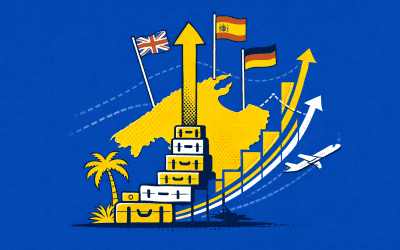
Mallorca’s demand profile is strongly Northern European, with the UK and Germany typically acting as core source markets for Spain and the Balearics.
At the national level, Spain set a record with 96.8 million international tourists in 2025, with the UK and Germany among the largest origin markets.
For Mallorca specifically, recent Balearics reporting highlights how international demand has been the stabilizer when domestic travel cools.
Why this matters: Mallorca’s business model is structurally tied to airlift and package-tour demand from a few high-volume markets. That concentrates both opportunity and risk.
How seasonal is tourism in Mallorca?
Mallorca is one of Europe’s clearest examples of peak-season concentration.
Even without a single “one-number” seasonality stat, the operational data makes the pattern obvious: hotel occupancy in the Balearics runs extremely high in late summer.
- In September 2025, the Balearic Islands posted 81.4% hotel occupancy (bed-places), with Palma–Calvià reaching 85.0% (and 88.1% on weekends).
This aligns with what residents experience: July–September is the pressure cooker period, and policies are increasingly designed to spread demand out of peak months rather than simply “grow arrivals.”
What role does Palma de Mallorca Airport play in the island’s tourism?
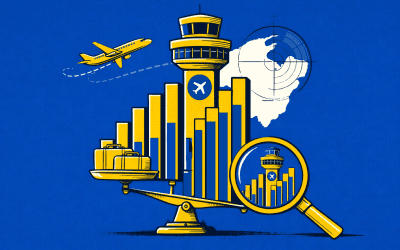
Palma Airport is the engine room of Mallorca tourism.
- 33.8 million passengers in 2025.
- Passenger mix is heavily tourism-driven: 73% leisure travel (vs. 5% business).
A practical implication: when air traffic slows or shifts, Mallorca feels it immediately. Conversely, when European aviation booms, Mallorca absorbs volume faster than many mainland destinations because it’s built for mass leisure travel.
How much money do tourists spend in Mallorca?
The trend Mallorca policymakers care about most is not just “more tourists,” but “higher value per tourist.”
- Average tourist expenditure per person in Mallorca reached €1,208 in 2024, up 8.5% year over year.
- Spain-wide spending benchmarks are also rising: in November 2025, average spending per international tourist was €1,399, with daily spend at €188.
- The Balearic Islands captured 17.5% of Spain’s cumulative international tourist spending (through November 2025), placing them among Spain’s top-earning tourism regions.
This supports the “quality over quantity” narrative: governments can justify tighter controls on accommodation supply if spend per visitor keeps rising.
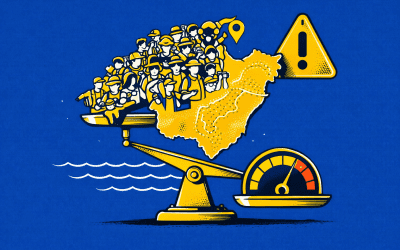
How much tourism pressure does Mallorca carry compared to the rest of Europe?
Mallorca’s scale is easier to understand when you look at nights, not arrivals.
- 47.2 million international tourist nights in 2023, the highest in the EU at the regional level.
That number explains why Mallorca is frequently at the center of Europe’s overtourism debates. It’s not only popular. It’s densely popular in a physically constrained geography.
How large is Mallorca’s accommodation capacity and why is it being capped?
Accommodation capacity is now political.
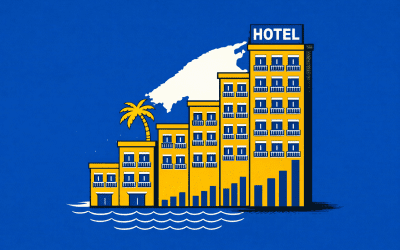
Mallorca has moved toward a bed-cap logic: instead of allowing unlimited growth in tourist accommodation, the island is increasingly managing supply via regulated bed counts.
One widely cited policy move is the plan to reduce the ceiling of tourist beds from 430,000 to 412,000, with allocations around 308,000 hotel beds and 104,000 rental-property beds.
The underlying rationale is straightforward:
- islands have hard limits on water, waste capacity, roads, and housing stock
- tourism growth competes directly with resident housing availability
- controlling beds is one of the few levers that directly controls peak population
How important is cruise tourism in Mallorca?
Cruise traffic is a separate pressure system because it delivers large surges into Palma’s city center.
Mallorca has discussed cruise limits and management, but stopovers remain substantial:
- Reporting for Palma has referenced ~1.8 million cruise passengers in the context of evaluating whether cruise limits are effective.
- Additional reporting indicates 511 cruise stopovers in 2025, slightly higher than the prior year.
Cruise tourism is a frequent target of “tourism saturation” criticism because spend per passenger can be lower than overnight tourism, while congestion effects can be immediate.
What policies does Mallorca use to manage tourism impact?
Mallorca and the Balearics use a mix of taxes, enforcement, and capacity controls.
A core tool is the Sustainable Tourism Tax, applied to overnight stays across accommodation types in the Balearics.
Revenue from the tax is explicitly linked to sustainability and public-space projects, including green space initiatives and destination rehabilitation.
This is important for competitiveness: Mallorca is effectively trying to keep the destination “high-functioning” while still operating at mass-tourism scale.
How visible is overtourism and resident pushback?
Mallorca has become one of Europe’s most visible overtourism flashpoints.
- Large anti-tourism demonstrations have taken place in Palma, with thousands protesting the effects of “touristification” and housing pressure.
Even when you set politics aside, the economic tension is real: when peak-season demand keeps climbing and housing supply is constrained, local rent pressure becomes part of the tourism story.
What does the outlook look like for Mallorca tourism in 2026?
The direction is not “grow at any cost.” It’s “manage capacity while increasing value.”
A few signals support that view:
- Balearics tourism remains at record levels in 2025.
- Palma Airport traffic remains huge, and leisure remains dominant.
- Spending per tourist in Mallorca is trending upward.
- Policy is explicitly shifting toward bed caps and sustainability-funded investment.
In practical terms, Mallorca’s next phase is likely to be defined by:
- tighter controls on short-term rental supply
- investment in infrastructure and environmental resilience
- attempts to shift demand into shoulder seasons
- continued conflict between growth incentives and housing constraints
Sources
- Annual Report of the Mallorca Sustainable Tourism Observatory (Data 2024). (pre-webunwto.s3.eu-west-1.amazonaws.com)
- Mallorca breaks historic tourist record in 2024. (Mallorca Preservation Foundation)
- Palma de Mallorca in figures (2025). (Aena)
- Tourism statistics at regional level (Mallorca international nights). (European Commission)
- Balearics surpass 19 million tourists in 2025. (Ultima Hora)
- Total Expenditure Survey (EGATUR) – November 2025. (Instituto Nacional de Estadística)
- International tourists spending (Balearic share of total). (La Moncloa)
- Sustainable Tourism Tax (ITS) overview. (Web GOIB)
- Balearic Islands direct eco-tax funding to green projects. (socialnewsroom.spain.info)
- Overtourism in Mallorca and tourist bed-cap policy. (KLEBER GROUP)
- Cruise pressure and passenger totals context. (Majorca Daily Bulletin)

Alison is a travel writer with a passion for solo adventures, photography, and Mediterranean escapes. She enjoys exploring Mallorca’s scenic coastline, charming villages, boutique hotels, and hidden gems, sharing stories that inspire curious travelers to discover the island beyond the obvious. Her work has been featured in outlets including Forbes, CNN, Travel + Leisure, and Yahoo.