
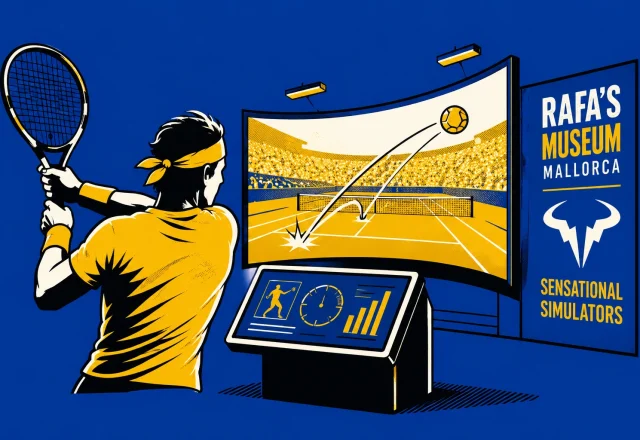
You don’t visit Rafa Nadal’s museum just to look at trophies.
You go to sweat, compete, and see if you can survive his world of high‑pressure sport.
The sensational simulators at Rafa’s museum turn a normal museum visit into a full-body workout. Here’s how to get the best out of them in 2026.
Inside Rafa Nadal’s Sport‑Xperience in Manacor
Rafa Nadal’s museum sits inside the Rafa Nadal Sports Centre in Manacor, Mallorca, on the same grounds as his academy. The space blends classic museum displays with a high-tech activity zone branded as Sport‑Xperience by Rafa Nadal.
You move from glass cases of Grand Slam trophies and signed shirts into dark, glowing rooms filled with screens, motion sensors, and simulators that react to every move. The shift from observer to participant happens fast.
The Xperiential Room: Where the Action Starts
The Xperiential Room is the main playground. Think of it as a compact sports arena wired with sensors, projectors, and simulators tuned for speed, accuracy, and endurance.
You’ll find a mix of solo and group activities. Some test pure reflexes, others focus on tactics, timing, or stamina. Staff usually brief you quickly, then let you compete against friends, family, or your own stats.
Tennis Simulator: Serve Like Rafa
The tennis simulator is the headline act for obvious reasons. You stand on a marked court facing a huge screen that projects a virtual opponent and court environment.
- A real racket, sometimes with sensors on the handle.
- Ball-tracking technology to read speed, direction, and spin.
- Match scenarios: defending break points, serving for the set, tie-break pressure.
The system reacts to your swing and shows ball trajectory in real time. You see instantly if your serve would have clipped the line or sailed long. It’s not Rafa’s 220 km/h cannon, but it gives you a feel for how small the margins are at the top.
Rowing Simulator: Power and Endurance Test
The rowing experience looks simple: a high-quality rowing machine facing an immersive screen. It’s anything but easy if you push it.
You row through virtual courses where the pace boat or ghost opponent adjusts to your performance. The faster and cleaner your strokes, the more fluid the virtual boat moves. Slack off for a few seconds, and you watch your rival pull away.
It’s a quick way to learn how elite rowers hold form under fatigue. And how quickly your arms and legs start burning.
Football Penalty Shootout: Beat the Keeper
The penalty simulator pits you against a virtual goalkeeper on a large screen. You place the ball, step back, and shoot toward marked zones that the system tracks with cameras or pressure sensors.
- Different difficulty levels with smarter, quicker keepers.
- Scoreboards showing power, accuracy, and placement.
- Time‑limited series to simulate penalty shootout drama.
It’s loud, fast, and surprisingly nerve‑shredding if others are watching. Especially when you sky your “winning” penalty into the virtual stands.
Mountain Bike Downhill: Control the Descent
On the MTB downhill simulator, you mount a fixed bike facing a curved or wide screen that throws you into rocky descents and forest trails.
The front fork and frame often move slightly to mimic bumps and turns. Your steering and pedalling are mapped to the track, so every late turn or overcorrection shows up on screen.
Expect sharp corners, sudden obstacles, and time splits that push you to risk more speed than you should. Just like real downhill riders do, minus the broken collarbone.
Formula 1 Racing: From Museum to Grid
The Formula 1 simulator is pure adrenaline. You sit in a cockpit-style seat with pedals, steering wheel, and big screen in front. Some setups add vibration to mimic kerbs and engine revs.
You race on recognisable circuits with lap times displayed after each run. Brake too late, and you run wide into gravel. Nail a corner sequence, and the timing screen glows green.
It’s a good reminder of how much mental processing it takes to drive a modern F1 car at speed, even in a controlled environment.
Climbing Challenge: Vertical Focus
The climbing challenge gives you a scaled, indoor experience of route‑finding and grip strength. Depending on configuration, you’ll either have:
- A physical climbing wall with colour‑coded holds and difficulty levels, or
- A hybrid system with projected routes and sensors checking your movements.
Either way, you’re fighting gravity and your own nerves as you move up. Short, intense climbs demand strong fingers and calm decision‑making when you realise you chose the wrong hold.
Tech That Makes the Simulators Feel Real
The simulators at Rafa’s museum lean on several shared technologies:
| Feature | What It Does |
|---|---|
| Motion & position sensors | Track your body, racket, or vehicle movement |
| High‑resolution projection | Create lifelike courts, tracks, and arenas |
| Real‑time physics engines | Simulate ball flight, traction, and impact |
| Haptic feedback (vibration) | Add weight, bumps, and engine rumble |
| Performance tracking & scoring | Log speed, accuracy, and reaction times |
You don’t have to know the tech details to enjoy it. But you’ll feel it when the system punishes a lazy backhand or a late braking point.
Beyond Simulators: Why the Museum Matters Too
The interactive area grabs the headlines, but the more traditional section of Rafa Nadal Museum Xperience gives you context.
You’ll see:
- Trophies from Grand Slams, Davis Cup, and the Olympics.
- Match rackets, shoes, outfits from key seasons.
- Donated items from stars like Michael Jordan, Usain Bolt, Cristiano Ronaldo, Michael Phelps, and Sebastian Vettel.
A huge 180‑degree panoramic screen runs highlight reels and compilations of famous sporting moments. The contrast between total stillness around a trophy cabinet and the roaring crowd on the screen hits hard.
Who Enjoys the Simulators Most?
The sensational simulators at Rafa’s museum work for different types of visitors, but in different ways.
- Tennis fans compare their serve speed and shot precision with what they’ve watched on TV for years.
- Families enjoy competing on short challenges where kids can genuinely beat adults.
- Casual tourists get an active break from beach‑only days in Mallorca.
- Sports science or coaching buffs like seeing how feedback and data change performance on the spot.
You don’t have to be fit to participate, but the competitive setups gently push you to move more than you planned.
Practical Visiting Info for 2026
Here’s how to plan a clean, stress‑free visit.
Location and Access
- Venue: Rafa Nadal Museum Xperience, Rafa Nadal Sports Centre
- City: Manacor, Mallorca, Spain
- Access: Around a 45–60 minute drive from Palma, depending on traffic.
Public transport options on the island change over time, so check local timetables if you’re not renting a car. Parking near the sports centre is typically straightforward outside peak hours.
Opening Hours and Tickets
Typical published hours:
- Opening: Daily, 10:00 AM – 7:00 PM
Ticket prices as of the latest available information:
- Adults: €18
- Children (6–12): €10
- Under 6: Free
Buy in advance through the official Rafa Nadal Museum website to lock in your slot, especially during school holidays and peak summer months.
Accessibility and Facilities
The museum sits inside a modern sports complex with lifts, ramps, and wide corridors, so visitors with reduced mobility can move around without major obstacles.
You also have access to:
- Onsite restaurants and cafés.
- The broader Rafa Nadal Academy facilities.
- Nearby parking and reception desks for extra help.
Tips to Get the Most from the Simulators
A bit of planning turns an hour of fun into a standout memory.
- Go early or late in the day. Midday crowds in summer can mean longer waits for the most popular simulators like tennis and F1.
- Wear trainers, not flip‑flops. You’ll be running, climbing, and rowing. Grip and stability matter.
- Rotate activities. Switch sports instead of repeating the same one ten times in a row. You stay fresher and compare skills across disciplines.
- Use the feedback. Check your stats screens. Simple tweaks in timing or body position often make a big difference on your second attempt.
- Mix simulators and exhibits. When your legs start complaining, wander through the trophy area, then come back for one last session.
Why These Simulators Hit Different
Plenty of attractions offer VR headsets or arcade‑style games. The sensational simulators at Rafa’s museum stand out because they’re firmly tied to real elite performance.
You watch Rafa lift a trophy, then step ten metres away and feel how demanding one point of his sport actually is. You see Michael Phelps’s medals, then realise how tiring a few minutes on a rowing machine can be.
The crossover between physical exertion and historical context makes the experience stick.
Start With One Simulator, Then Explore the Rest
If you’re short on time, start with:
- Tennis simulator if you care most about Rafa.
- Formula 1 if you love speed and precision.
- Penalty shootout if you’re there with kids or a group that wants lots of laughs.
Once you’ve tried one, it’s hard not to queue for the next.
To check current schedules, updated pricing, or special events linked to tournaments or Rafa’s appearances, go straight to the official Rafa Nadal Museum website.
And if you’re planning a trip to Mallorca in 2026, put a few hours aside in Manacor. Your body might complain, but your inner sports fan will thank you.

Alison is a travel writer with a passion for solo adventures, photography, and Mediterranean escapes. She enjoys exploring Mallorca’s scenic coastline, charming villages, boutique hotels, and hidden gems, sharing stories that inspire curious travelers to discover the island beyond the obvious. Her work has been featured in outlets including Forbes, CNN, Travel + Leisure, and Yahoo.